CS2 Trade Updates 2025: Trade Protection and Knife Trade-Ups Explained
A complete breakdown of Valve's major 2025 CS2 trading updates — the July Trade Protection system with 7-day reversals, and October's game-changing knife and glove Trade Up Contracts.
2025 has been a landmark year for CS2 trading. Valve rolled out two major updates that fundamentally changed how skins are traded and crafted — the July "Trade Protection" system designed to combat scams, and the October Trade Up Contract expansion that made knives and gloves craftable for the first time. Both updates sent shockwaves through the community and reshaped the skin economy.
This article breaks down everything you need to know about these updates, how they work, and their impact on the market.
Part 1: Trade Protection (July 2025)
On July 15th, 2025, Valve introduced Trade Protection — a security feature that allows players to reverse any CS2 trades made within the past seven days. Think of it as an "undo" button for skin transactions, designed to protect players from scams and account compromises.
How Trade Protection Works
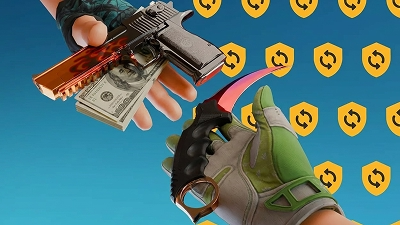
When you complete a trade, your items are delivered instantly and you can equip them right away. However, for the next seven days, these items carry a "Trade Protected" status, marked with a yellow shield icon in your inventory.
During this protection window, if you realize your account was compromised or you were scammed, you can reverse all recent trades with a single click — no need to contact Steam Support.
The Reversal Process
Reversing trades is straightforward but comes with consequences:
- Navigate to your trade history and click the reversal button
- All trades from the past 7 days involving protected items are reversed simultaneously
- Your account receives a 30-day trading cooldown for CS2 skins
- You're signed out of Steam — Valve recommends changing your password immediately
The system operates on an all-or-nothing basis. You cannot selectively reverse specific trades; initiating a reversal rolls back everything from the past week.
Restrictions During Protection
Trade Protected items have significant limitations during the 7-day window:
- No consuming items — Can't open cases or use sprays
- No modifying items — Can't apply or remove stickers, add or remove name tags
- No transferring items — Can't trade protected items again
- No storage unit moves — Can't move protected items into storage
Additionally, Trade Protected (CS2) and non-protected (other game) items cannot be mixed in the same trade. This effectively ended cross-game trading scenarios like swapping Rust skins for CS2 skins.
The Controversy: A New Scam Vector?
While Trade Protection aims to prevent scams, the community quickly identified a critical flaw: the feature could actually facilitate a new type of scam.
Here's the problem: trades can be reversed for 7 days, but money transactions (via PayPal, crypto, or other external methods) cannot. A bad actor could:
- Sell skins for real money on a third-party marketplace
- Receive payment
- Reverse the trade within 7 days
- Keep both the money and the skins
This vulnerability forced third-party marketplaces to adapt quickly. Most platforms now hold seller funds for 7 days before payout, effectively adding a week to every transaction.
Impact on Third-Party Trading
The update caused immediate chaos in the trading ecosystem:
- Many platforms temporarily suspended operations to assess the implications
- 7-day holding periods became standard for marketplace payouts
- Cash trading became significantly riskier for buyers paying outside Steam
- Some traders migrated to platforms with escrow protection
For sellers on platforms like SkinBaron, DMarket, or Skinport: when you list items, they remain in Trade Protected status for 7 days before appearing on the marketplace.
Future Expansion
Valve announced that Trade Protection will expand to other Steam games in the future. While the timeline isn't confirmed, games with active trading economies like Dota 2, TF2, and Rust are likely candidates.
Part 2: Knife and Glove Trade-Ups (October 2025)
On October 23rd, 2025, Valve dropped what many consider the most controversial update in Counter-Strike history: knives and gloves became craftable through Trade Up Contracts.
For the first time ever, players could exchange five Covert (red) tier skins for a guaranteed knife or glove from the same collection. The market impact was immediate and catastrophic.
How Knife Trade-Ups Work
The new Trade Up mechanic differs from traditional contracts:
| Traditional Trade-Up | Knife/Glove Trade-Up |
|---|---|
| 10 items required | 5 items required |
| Output is one tier higher | Output is "gold" tier (knife/glove) |
| Works with any rarity | Requires Covert (red) items only |
The process:
- Insert 5 Covert skins from collections containing knives or gloves
- The game rolls from one of the collections represented by your inputs
- Output float equals the average of your five inputs, adjusted for the knife/glove's min-max caps
- If all inputs are StatTrak™, the output is StatTrak™ (always a knife, since gloves don't have StatTrak)
Strategic Collection Targeting
Smart traders quickly figured out how to manipulate outcomes:
For guaranteed Butterfly knives: Use only Covert skins from the Operation Breakout Weapon Case — it's the only case with exclusively Butterfly knife gold drops.
For Sport Gloves Vice: Feed the contract five Covert skins from the Clutch Case to lock results to that glove pool.
The key rule: Mixing collections splits your odds across all represented gold items. Stick to one case for 100% control over which knife or glove category you target.
The Market Apocalypse
The economic impact was immediate and brutal:
Knife prices collapsed:
- Fade M9 Bayonet: $2,450 → $700 in two days
- Overall knife/glove market: ~50% value drop
- Total market value lost: Over $1.75 billion
Covert skins exploded:
- Buy volume spiked 400% overnight
- Items like P90 Asiimov and MP9 Starlight Protector jumped 5-10x in price
- Cheap Coverts became "fuel" for knife crafting
One player's reaction captured the community sentiment: "My knife just dropped $1,400 in value in the span of 30 minutes."
Winners and Losers
Winners:
- Players holding large quantities of cheap Covert skins
- Those who sold knives/gloves before the update
- Gamblers willing to trade-up for knife crafting
Losers:
- Knife and glove collectors/investors
- Anyone holding high-tier inventory when the update dropped
- Players who bought knives days before the announcement
The update effectively redistributed wealth across the CS2 economy. Long-time collectors saw portfolios devastated while opportunistic traders profited massively.
Crafted Item Restrictions
Items created through the new Trade Up Contract have a 7-day trade hold before they can be sold or traded. This aligns with the Trade Protection system introduced in July.
What These Updates Mean for Traders
For Casual Players
- Trade Protection provides peace of mind — Account compromises are less devastating
- Knife crafting creates new paths to rare items — No longer limited to case openings or marketplace purchases
- Prices for knives and gloves are more accessible — The October crash made high-end items cheaper
For Serious Traders
- Factor in 7-day holds when planning transactions
- Third-party marketplace payouts now take longer — Build this into your cash flow expectations
- The Covert skin market is now intertwined with knife values — Monitor both when making decisions
- Inventory diversification matters more than ever — Single-item holdings carry higher update risk
For Developers Building Trading Tools
Both updates have significant implications for trading applications:
- Track Trade Protected status via inventory APIs
- Calculate trade-up outcomes for the new 5-item knife/glove contracts
- Monitor price volatility more closely — Valve updates can crash markets in hours
- Build 7-day hold awareness into transaction flows
SteamApis provides real-time market data and inventory information to help you build applications that account for these new mechanics.
Looking Ahead
Valve has signaled that Trade Protection will expand to other games, and there's no telling what future economy changes might come. The 2025 updates proved that even established markets can be upended overnight.
For traders and developers alike, staying informed and adaptable is more important than ever. The CS2 skin economy continues to evolve, and these updates are likely just the beginning of Valve's efforts to reshape how virtual items are traded on Steam.